"Our doctors at Allen Spine and Sport are dedicated to not only relieving pain, but creating long-lasting, functional results through the integration of all the services described below."
Our Services
-

Chiropractic Care
Chiropractic care is non-invasive. holistic, and drug-free. Regular chiropractic care can help you live a healthy and pain free lifestyle.
Chiropractic adjustments reduce spinal joint restrictions to help with joint mobility leading to relaxed muscles and improved nervous system function.
Common symptoms we treat:
Neck pain
Back pain
Headaches
TMJ dysfunction
Shoulder and hip pain
-

Pregnancy Care
Gentle and specific adjustments during pregnancy can help an expecting mother’s body as it starts to undergo changes as baby grows. Chiropractic care during pregnancy plays an important role in helping with the mobility of joints, tone of muscles, and supporting proper position of baby leading to an easier and more comfortable pregnancy and birth. Dr. Kayla has specialized training in pregnancy care as well as a pregnancy tailored table and pillows.
Common symptoms we treat:
Pubic pain
Hip & back pain
Sciatica
Round ligament discomfort
Carpal Tunnel Sundrome
-

Pediatric Care
During the first 5 years of a child’s life majority of growth happens. Chiropractic care for children is gentle and effective in helping them during their development and growth. Dr. Kayla has specialized training in the pediatric population to help keep their spines healthy.
Common symptoms we treat:
Latching issues
Sleeping issues
Tongue/lip tie
Constipation
Colic
Reflux
-

Dry Needling
Dry needling has two main treatment uses: trigger points and blood flow for healing. With treatment of trigger points, we find “tight spots” in muscles that can contribute to pain and dysfunction. We then insert very thin microfilament needles into those trigger points. The process re-orients the covering of the muscle (fascia) and results in the muscle relaxing and removal of the trigger point. For the goal of increasing blood flow, needle insertion restarts the inflammatory process and brings more blood to the area for healing. This process can be thought of as a “controlled re-injury.” Dry needling can result in slight soreness but nothing that should last more than a day or two. The process overall involves very little pain when done efficiently.
-

Soft Tissue Techniques
IASTM
Cupping
Fascial Manipulation
Myofascial Release
Several therapies designed to help remove trigger points and break down fascial adhesions and help facilitate normal muscle tone and better function of surrounding joints and muscles.
Common conditions we treat:
Plantar fasciitis
Carpal tunnel syndrome
Neck, shoulder, back and extremity pain
Post-surgical scars
Sprain/strains
Tendinitis
-

Kinesiotaping
Kinesiotaping is designed to help facilitate healing in muscles. Kinesio-tape provides support for the surrounding joints to help stabilize them during daily activities and exercise to decrease pain and irritation.
Common symptoms we treat:
Round ligament pain
Coccyx/tailbone pain
Myofascial discomfort
Tendinitis
-

McKenzie Method
MDT is a highly effective assessment and treatment system that classifies neuromusculoskeletal patients into 1 of 4 buckets. Classification of pain is quite helpful for patients to understand what’s causing the pain, what we’re going to do to reduce pain and most importantly, how we’re going to prevent the pain from coming back. In a nutshell, it involves utilizing a variety of movements and positions to find a “directional preference,” with which we can often make dramatic improvements to some otherwise tricky conditions. Dr. Forrest is fully certified in MDT.
-

Webster Technique
Dr. Kayla is certified in the Webster Technique through the ICPA to help with a mother’s growing belly and baby’s natural positioning. The Webster Technique is a specific sacral analysis and adjustment done during pregnancy. The goal of the adjustment is to reduce the effects of sacroiliac joint dysfunction. This helps with the neuro-biomechanical function in the pelvis allowing for reduced intrauterine constraint and decreased dystocia (difficult labor). The technique also involves a specific abdominal tension release in the round ligaments. This helps not only a pregnant mother’s discomfort but it allows baby to be in the most optimal position in-utero. For more information please visit icpa4kids.org.
-

Dynamic Neuromuscular Stabilization (DNS) Rehab
Rehabilitation including targeted and active exercises are how we create long-lasting results at Allen Spine and Sport. Dr. Forrest is trained and certified in Dynamic Neuromuscular Stabilization (DNS) as both a practitioner and an exercise trainer. Joint manipulation is our most effective tool for improving mobility in the joint regions that are restricted, and DNS is our most effective tool for ensuring the patient/athlete can control and maintain this new mobility. DNS is truly the lens we look through when evaluating each patient’s movement patterns to determine how we can create the most long-lasting results.
-
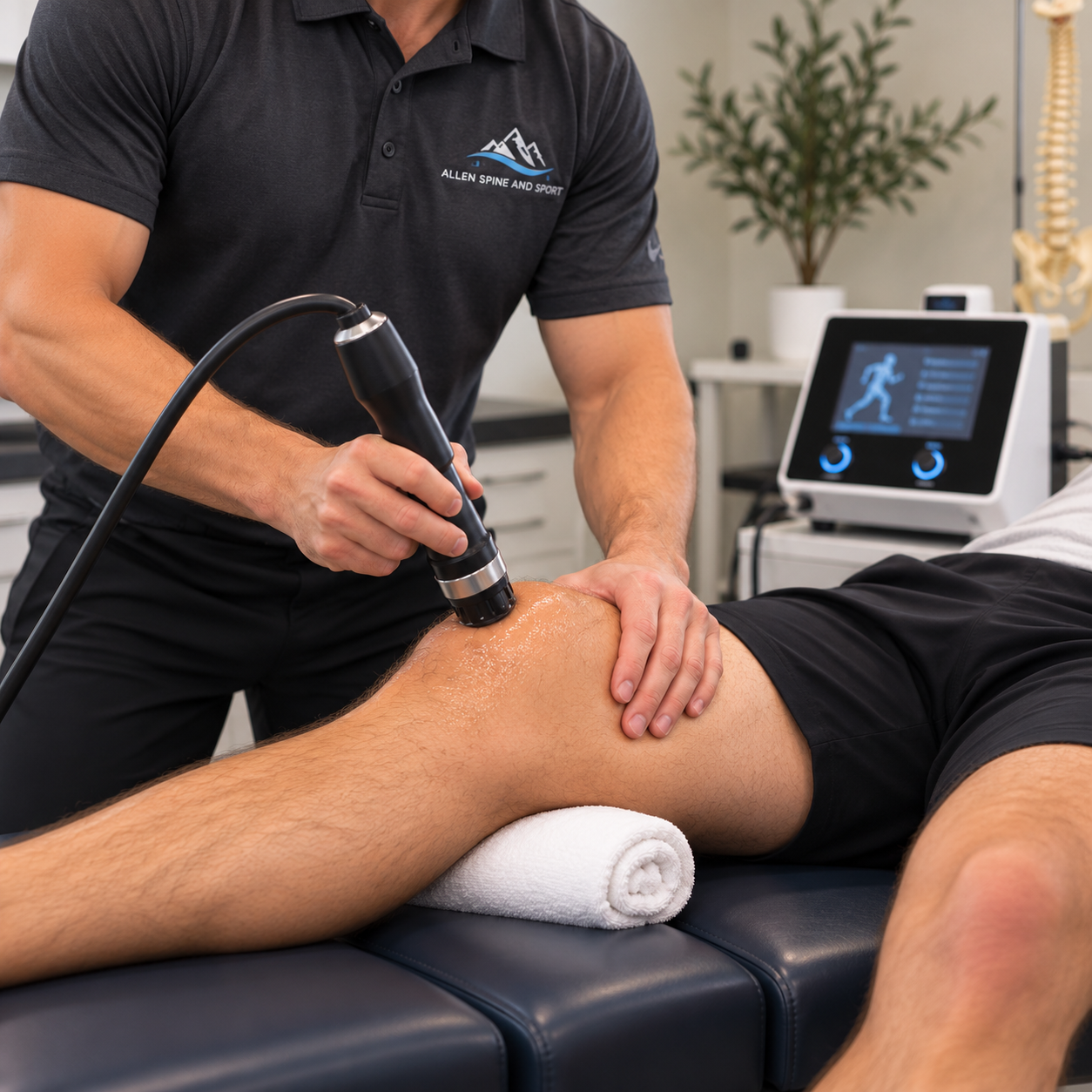
Shockwave Therapy
Shockwave therapy is a noninvasive treatment that delivers focused acoustic (sound) waves to targeted tissues. It is used to reduce pain, stimulate healing, and improve function in musculoskeletal conditions, especially tendinopathies and certain chronic soft-tissue injuries.
improves blood flow, reduced local inflammation, stimulation of tissue regeneration, and breakdown of calcifications in some cases.
Common indications
Plantar fasciitis
Tendinopathies
Muscle and Connective Tissue injuries
Lateral epicondylitis (tennis elbow)
C-section scar repair and skin tightening
Rotator Cuff Injuries